From Budget Printer to Professional Prototyping Tool
I started with a stock Ender 3 V2, but my goal was ambitious: push it to perform on the same level of speed as my Bambu Lab P1S. Step by step, I transformed it into a high-performance machine capable of 500 mm/s print speeds and up to 20,000 mm/s² acceleration.
What began as a budget printer is now a near-professional prototyping tool that comes close to my P1S in speed and efficiency. More than just hardware upgrades, this project taught me core principles of mechatronics, firmware optimization, and mechanical engineering, turning the Ender 3 V2 into a hands-on learning platform.
I started with a stock Ender 3 V2, but my goal was ambitious: push it to perform on the same level of speed as my Bambu Lab P1S. Step by step, I transformed it into a high-performance machine capable of 500 mm/s print speeds and up to 20,000 mm/s² acceleration.
What began as a budget printer is now a near-professional prototyping tool that comes close to my P1S in speed and efficiency. More than just hardware upgrades, this project taught me core principles of mechatronics, firmware optimization, and mechanical engineering, turning the Ender 3 V2 into a hands-on learning platform.
Performance Statistics
500
mm/s Max Speed
20,000
mm/s² Acceleration
~95%
P1S Performance Match
6+
Major Upgrades
Key Upgrades & Learning Outcomes
Extruder System
Orbiter V2.5 Extruder + Phaetus Hotend
Lightweight, high-torque setup for reliable extrusion at high speeds.
Dramatically improved print quality and reduced weight on the print head.
Learned: extrusion dynamics, retraction tuning, torque-to-weight optimization
Motion System
Linear Rails (X & Y Axes)
Replaced V-wheels with precision linear rails for smoother, more rigid motion system.
Eliminated play and improved positioning accuracy significantly.
Learned: CNC tolerancing and the mechanics of precision motion
Frame Stability
Dual Z-Axis + Frame Modifications
Enhanced gantry stability with dual Z-motors and reinforced frame structure.
Slightly increased X-height for better part clearance.
Learned: structural rigidity and stress distribution in mechanical systems
Auto-Leveling & Cooling
CR Touch + Hero Me 7 Cooling
Automated bed leveling for consistent first layers and optimized part cooling
airflow for high-speed printing without quality loss.
Learned: the balance of automation, mechanics, and cooling on print quality
Control System
BTT E3 V3.0 + Klipper Firmware
Advanced 32-bit control board with Klipper firmware featuring input shaping
and resonance compensation for high-speed printing stability.
Learned: system identification, firmware tuning, and motion control theory
Calibration Tools
Accelerometer Integration
Added accelerometer for automated resonance testing and input shaping
configuration, enabling optimal high-speed performance tuning.
Learned: vibration analysis and automated system optimization techniques
Before vs After Comparison
Specification
Stock Ender 3 V2
Custom Build
Max Print Speed
50-80 mm/s
500 mm/s
Acceleration
500-1000 mm/s²
20,000 mm/s²
Motion System
V-wheels on aluminum
Linear rails
Extruder
Bowden tube
Orbiter V2.5 direct drive
Auto-leveling
Manual bed leveling
CR Touch auto-leveling
Firmware
Marlin (basic)
Klipper + input shaping
Z-axis
Single motor
Dual motor system
Project Gallery
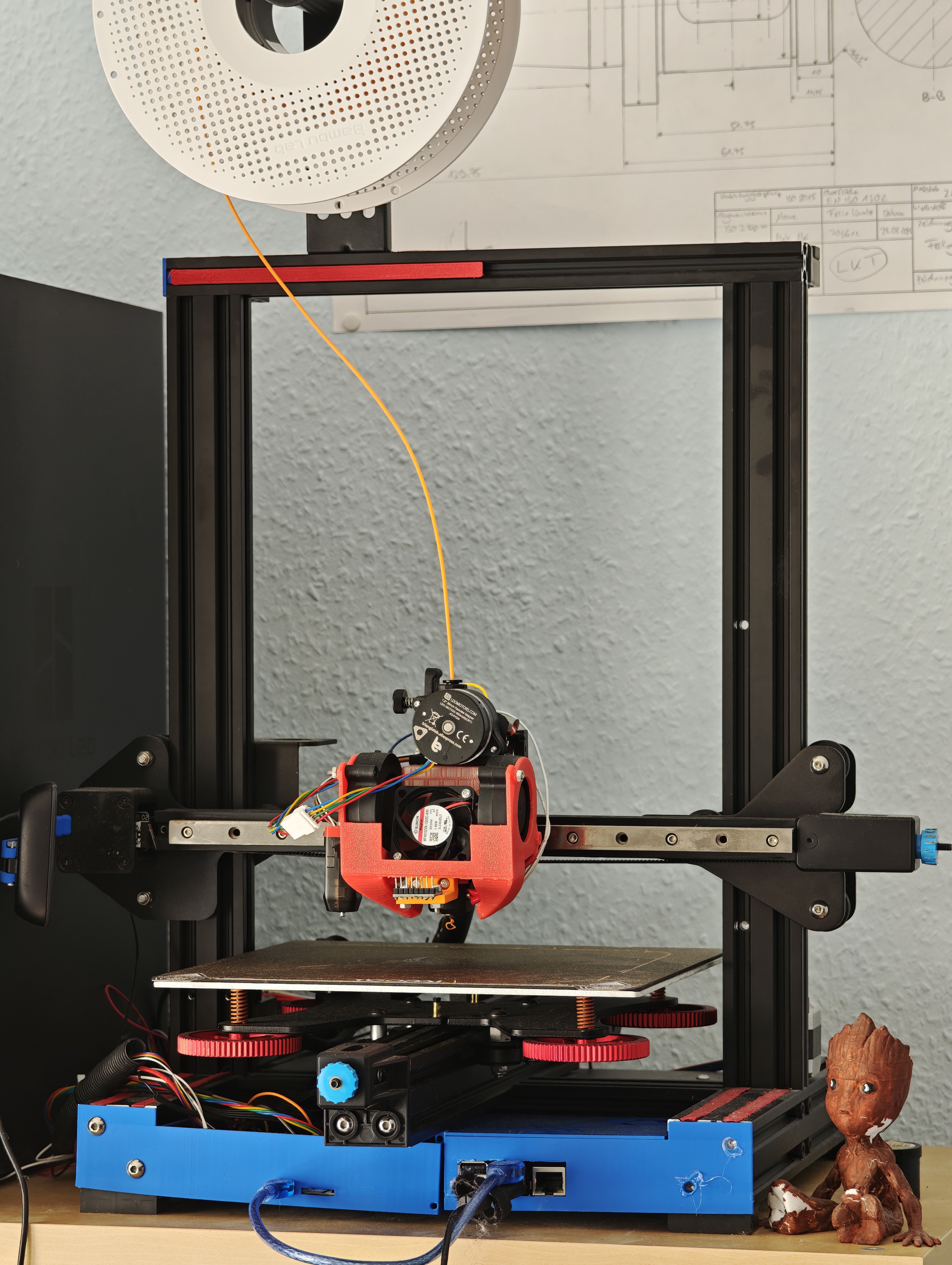
complete_build_overview.jpg
Complete build showing all major upgrades: linear rails, dual Z-axis, Hero Me 7 cooling shroud,
and the compact Orbiter extruder. Note the engineering drawings in the background and the
cute Groot figurine standing guard over the print bed.
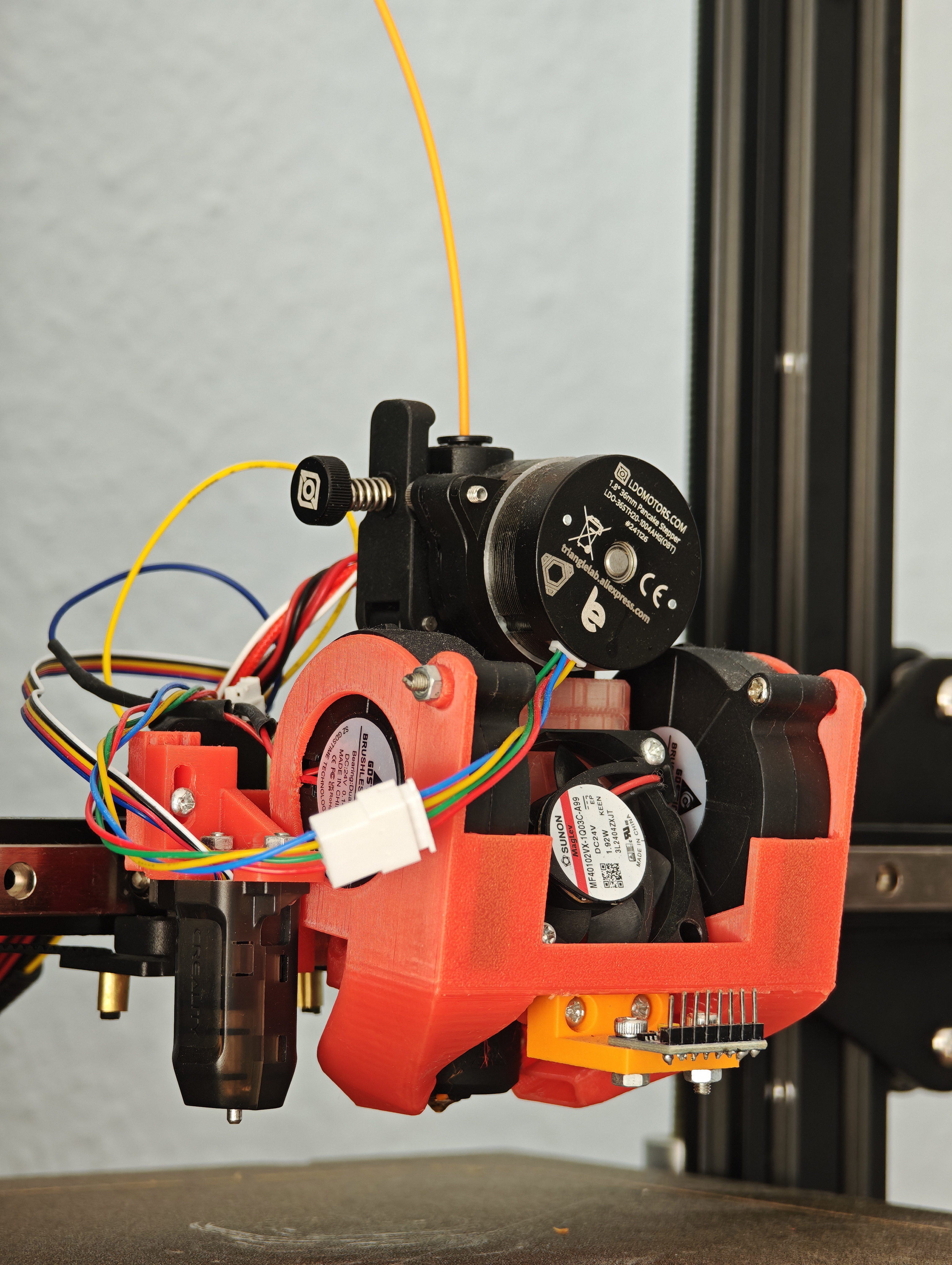
extruder_detail_closeup.jpg
Detailed view of the Orbiter V2.5 direct drive extruder with Phaetus hotend.
Shows the precision engineering of the lightweight design, optimized cable management,
and the Hero Me 7 cooling system with dual fans for optimal part cooling.
high_speed_printing_demo.mov
Live demonstration of high-speed printing capabilities showing the printer
operating at maximum performance with smooth, precise movements enabled by
the linear rail upgrades and Klipper firmware optimization.
Technologies & Skills Developed
• Mechatronics Integration: Understanding how mechanical, electrical, and software systems work together in precision machinery.
• Firmware Development: Configuring and optimizing Klipper firmware for maximum performance and reliability.
• Motion Control Theory: Learning about input shaping, resonance compensation, and vibration analysis.
• Mechanical Engineering: Frame rigidity, stress distribution, and precision motion system design.
• System Optimization: Using accelerometers and data analysis to achieve optimal performance tuning.
• Cost-Effective Engineering: Achieving professional-grade performance on a budget platform through strategic upgrades.
• Firmware Development: Configuring and optimizing Klipper firmware for maximum performance and reliability.
• Motion Control Theory: Learning about input shaping, resonance compensation, and vibration analysis.
• Mechanical Engineering: Frame rigidity, stress distribution, and precision motion system design.
• System Optimization: Using accelerometers and data analysis to achieve optimal performance tuning.
• Cost-Effective Engineering: Achieving professional-grade performance on a budget platform through strategic upgrades.
Technical Specifications
Component
Specification
Performance Gain
Mainboard
BTT E3 V3.0 32-bit
Advanced processing power
Extruder
Orbiter V2.5 Direct Drive
High torque, low weight
Hotend
Phaetus Dragonfly
High-temp, fast heating
Motion
MGN12H Linear Rails
Precision + rigidity
Firmware
Klipper + Input Shaping
500mm/s+ capability
Cooling
Hero Me 7 Dual Fan
High-speed cooling